

The history of lapidaries
In a few words, the lapidary saws, cuts and polishes precious and semi-precious stones to reveal their brilliance and expose all their colors. He is an essential player in the world of jewelry.
The cutting of precious and semi-precious gemstones appeared in Geneva in the thirteenth century. The lapidary industry developed in France in the sixteenth century, when Catholic watchmakers fled Protestant persecution in Geneva and settled in the Jura. They cut rubies for watches (counter-pivots) and later gemstones for jewelry. Stone cutting was mainly carried out in winter, when outdoor work was limited. In the eighteenth century, Jura cutting workshops began exporting their products to Paris, and the first brilliant cuts with thirty-two facets appeared. Some villages, including Septmoncel, Les Molunes, Lajoux and Lamoura, depended mainly on gemstone cutting. The first rhinestones, synthetic minerals, doublets and triplets then appeared between Paris and the Jura region. Cutting methods also evolved, and the mechanical stick took various forms. It could be used to cut one stone, then two, then four. Eventually, stone holders could hold one hundred stones at a time. Methods were then developed to cut the thirty-two facets of a brilliant cut in a single operation.
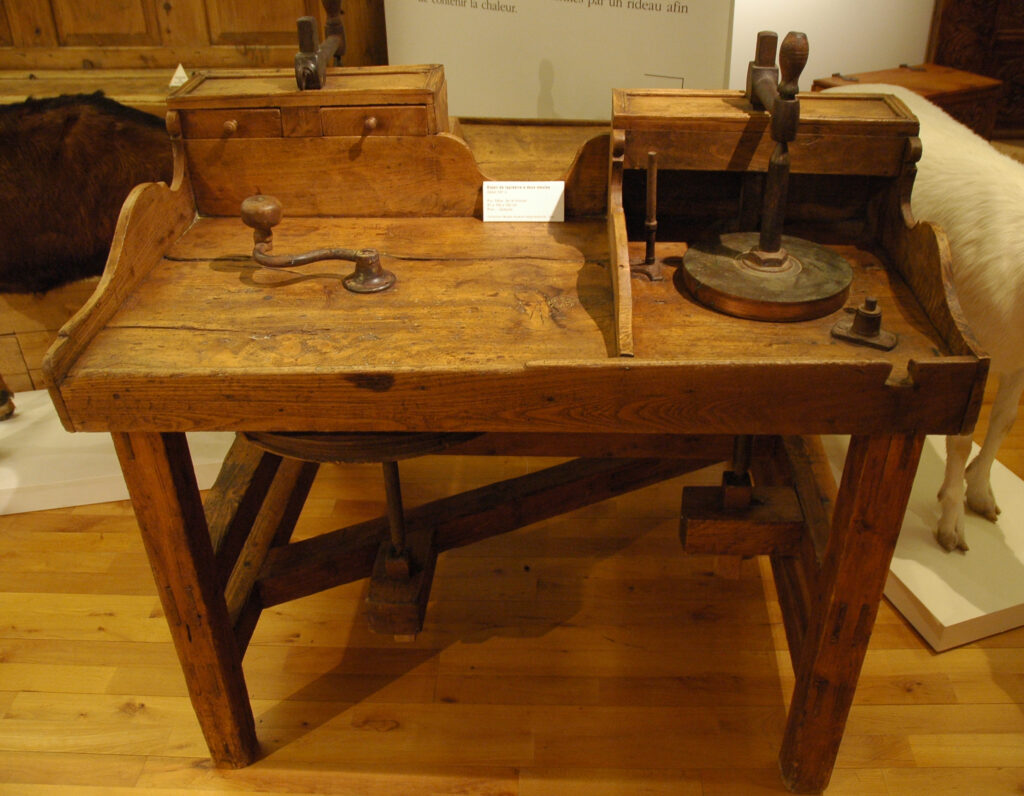

“After caring for the animals and milking, the peasant couple cut and polished for the town or village workshops. The man operated his copper grindstone with his left hand by a crank located on the left half of the rustic and solid 4-legged workbench; with his right hand he presented a stone holder on the grindstone and by successive rubbings cut the stone facet after facet. His wife, in front of him, polished the stones on a softer bronze wheel coated with an abrasive powder: tripoli.
Saint-Louis having approved the statutes of the Corporation of journeyman goldsmiths, crystal makers or stone workers (later called lapidaries) naturally became the patron of this corporation. The lapidaries had their own festival on the 1st Sunday in August (Saint-Etienne).”
LE HAUT-JURA OUBLIE, Daniel CHAMBRE (1998)
It is estimated that, depending on the period, there were between one thousand and ten thousand lapidaries in the Jura, particularly in the Haut-Jura, from the eighteenth to the early twentieth century. Today, only a few dozen, or perhaps a hundred, professional lapidaries remain in France. By comparison, Thailand alone has tens of thousands of lapidaries. Gemstone cutting is also widespread in India and South America, mainly Brazil and Colombia.